Authors: Zachary Amir (TERN), Jenna Wraith (QCIF), Matthew Scott Luskin (UQ), Renuka Sharma (QCIF)
TABLE OF CONTENTS
- 1. Data licensing
- 2. Persistent Identifiers (PIDs)
- 3. Data sharing options
- 4. Data curation & usage
- 5. Sensitive data handling
- 6. Embargo periods
- 7. WildObs Image Platform data-sharing controls
- 8. Compliance & legal considerations
- 9. Agreement acceptance
1. Data licensing
All species detections and metadata hosted in the WildObs camera trap database (CamDB) must be covered by a permissive license to align with FAIR principles (Findability, Accessibility, Interoperability, and Reusability). Creative Commons (CC) licenses are preferred, but flexibility is allowed where necessary. WildObs offers three data-sharing options - Open, Partial, and Closed. Partial sharing (of metadata only, no species detections) is discouraged because it does not promote transparency and collaborative research. We only offer closed data in certain circumstances. Please get in contact with us to talk about this option. An immediate embargo period of up to 24 months is available for those who need temporary data restrictions, which can be extended as needed.
2. Persistent Identifiers (PIDs)
Each dataset hosted in the CamDB will have at least one Persistent Identifier (PID). Internal PIDs are assigned to all datasets and are used for internal tracking and organization. Research Activity Identifiers (RAiDs) will be assigned to all datasets without a closed data-sharing agreement and are minted by WildObs. RAiDs are a PID initiative from the Australian Research Data Commons, and you can learn more about RAiDs here, and see an example WildObs minted RAiD here. Digital Object Identifiers (DOIs) will be assigned to datasets with an open data-sharing agreement and minted by our external hosting solutions. Both RAiDs and DOIs provide a stable citation reference, supporting FAIR principles.
- Open data: Internal PIDs assigned within WildObs, RAiDs assigned via WildObs, and DOIs assigned via an external hosting solution.
- Partial data: Internal PIDs assigned within WildObs, and RAiDs assigned via WildObs. Upon embargo expiration, the data will be assigned a DOI via an external hosting solution
- Closed data: Only internal PIDs assigned within WildObs.
3. Data sharing options
WildObs recognises the importance of respecting data provider preferences while promoting open data access. Data ownership remains with the provider. For more information on the content of data package files, visit WildObs data standards. Sharing options include:
Open data (preferred)
- Metadata, images, and species detections are openly available in public repositories with a RAiD and/or DOI.
- All files of the Camtrap DP dataset package, along with WildObs-specific covariates.csv and additional datapackage.json fields can be queried or downloaded from WildObs or other partner platforms.
- Fully adheres to FAIR principles.
- Unlimited access to the provider via the WildObs Database Online Dashboard.
- License: CC-BY (attribution required).
- Enables unrestricted use for conservation and scientific advancements.
- No remaining embargo period.
- Metadata, images, and species detections will be made available via external hosting solutions.
- The Atlas of Living Australia (ALA) will host occurrence records and tagged images for the Tagged Image Repository.
- The Terrestrial Ecosystem Research Network (TERN) will host structured survey data in the EcoPlots platform.
Partial data sharing (discouraged)
- The metadata is public (e.g., spatial-temporal extent of camera deployments, contact details) and visible via the WildObsR R package and WildObs Database Online Dashboard with a RAiD.
- No species detections are made public; metadata describing how the project was implemented are public on WildObs or with partner platforms.
- The data provider can be contacted by interested parties to request that data be shared directly for research purposes.
- Metadata, images, and species detections are retained internally at WildObs with unlimited access to the provider.
- Metadata and species detections can be shared with government and biodiversity metric authorities (e.g., the Threatened Species Index).
- Species detections are not publicly accessible.
- Images are made available in the Tagged Image Repository but stripped of the metadata required for other purposes.
- License: CC-BY (attribution required).
- A maximum embargo period of 24 months can be applied.
- Intended for cases where provenance retention (e.g., Indigenous data sovereignty) is necessary.
- The provider can specify whether partial species detection data may be contributed to ALA in some form, depending on agreements. An example could be sharing presence-only data, but not the full detection histories.
Closed data (by agreement only)
- WildObs is open to supporting projects that require closed data in exchange for support of the WildObs project, financial or otherwise.
- Metadata, images, and species detections remain private, with unlimited access to the provider via the WildObs Database Online Dashboard.
- Metadata, images, and species detections are retained internally at WildObs, not the public.
- There is no public access for metadata, images, or species detections.
- Institutional Memorandums of Understanding (MoUs) can be developed to facilitate the transition of data to open or partial sharing.
- Internal PIDs only; no RAiD or DOI assignment.
- Closed data will not be provided to ALA or TERN
4. Data curation & usage
WildObs retains curation rights, including:
- Standardising metadata, images, and species detections for interoperability.
- Conducting quality control and refining detection records.
- Using shared data to train AI models and analytical workflows.
- Facilitating data discoverability through external repositories (where applicable).
- Wrangling and modifying datasets where required to ensure quality and usability.
- Assisting with licensing selection to ensure alignment with best practices.
5. Sensitive data handling
When sharing data publicly, WildObs will adhere to ALA’s clear and conservative policy of obfuscating locations for threatened species (see Working with threatened, migratory, and sensitive species information in the ALA). For other uses of sensitive location data, such as the presence of threatened species, the provider can provide their preferences. This may include obscuring coordinates or restricting site identifiers before external sharing. Data sensitivity classifications will be determined in consultation with data providers.
6. Embargo periods
Embargo periods of up to 24 months can accommodate data providers' concerns, and these can be extended as needed. Data providers will receive an email from data@wildobs.org.au 3 months prior to their embargo expiry date, with the opportunity to extend. All open datasets with an existing embargo period default to a partial data sharing agreement, in which metadata will still be discoverable but not species detections. After the embargo expires, the dataset will transition from partial to open data sharing unless alternative requests are made.
7. WildObs Image Platform data-sharing controls
This section applies specifically to projects managed through the WildObs Image Platform (wimp.wildobs.org.au). For legacy projects and data shared via survey.wildobs.org.au, refer to Sections 2–6 above.
Any data already shared via the WildObs Image Platform is currently treated as closed by default. It will only be made open or partial with your explicit consent — we will contact you directly to confirm your preference before any change is made. In an upcoming release, you will be able to select when you are ready to publish your data on the WildObs database and set your embargo period directly from the "Export data" page in the platform interface.
Providers can control certain aspects of data visibility directly in Project settings:
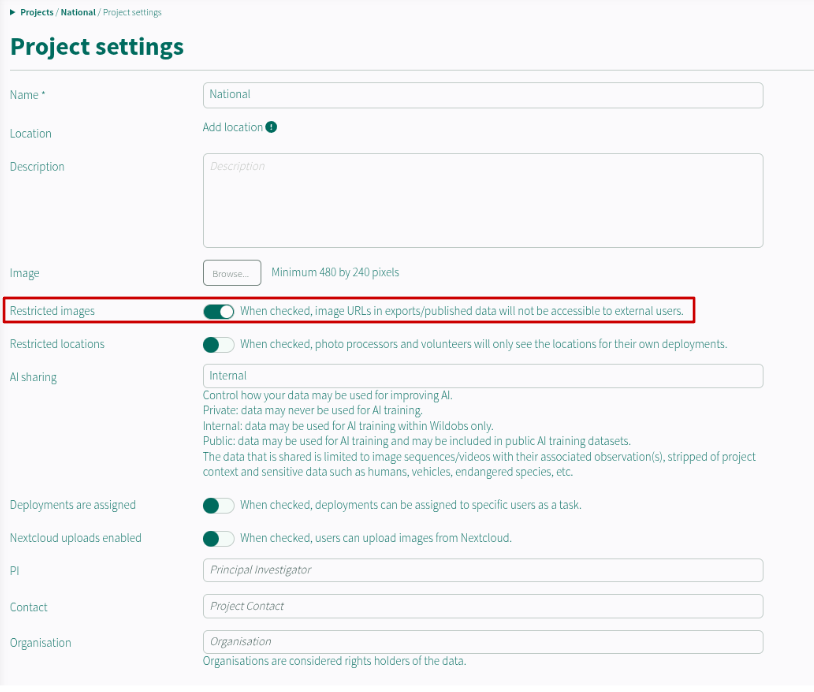
- Restricted images – when enabled, image URLs are excluded from exports and published data, so they are not accessible to external users.
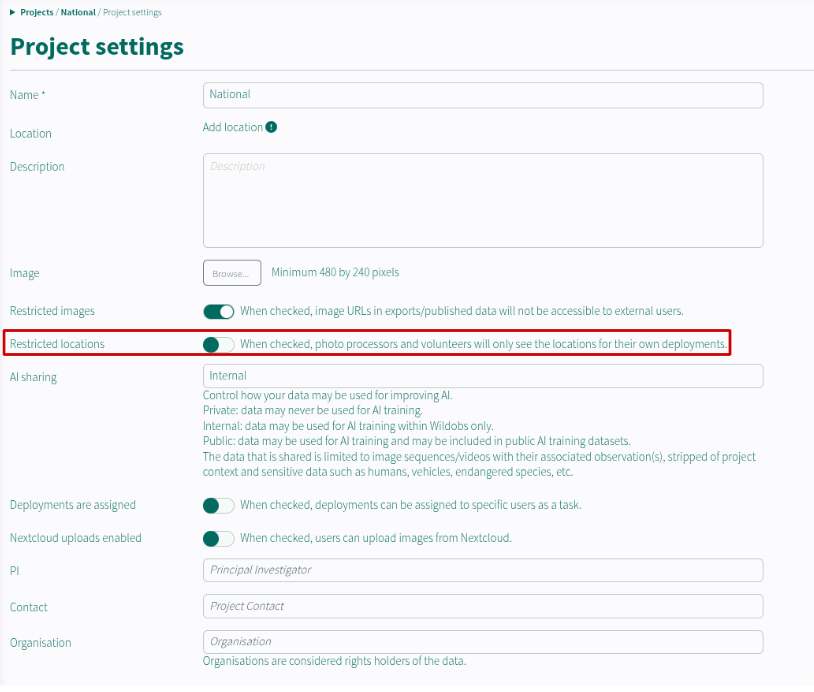
- Restricted locations – when enabled, photo processors and volunteers can only see the locations of deployments assigned to them.
New as of 17 Jul 2026: A separate AI sharing drop-down controls whether project data may be used for AI training, independent of the settings above. Options are Private (never used for AI training), Internal (may be used for AI training within WildObs only), and Public (may be used for AI training and included in public AI training datasets). Any data shared for AI training is limited to image sequences/videos with their associated observations, stripped of project context and sensitive data such as humans, vehicles, and endangered species. All existing projects created before this date have had AI sharing set to Internal by default. Providers who want a different setting should review and update their Project settings accordingly.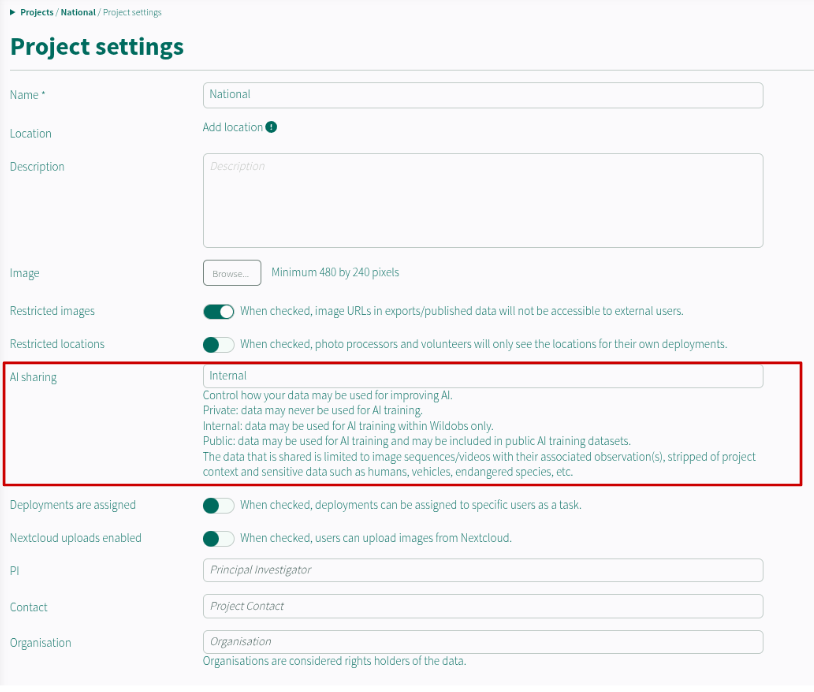
8. Compliance & legal considerations
This agreement aligns with policies from ALA, EcoCommons, EcoSounds, TERN, and the Threatened Species Index. Data providers must ensure compliance with relevant legal, ethical, and institutional policies. Intellectual property ownership of datasets remains under review and may require additional agreements.
9. Agreement acceptance
By contributing data to WildObs, the provider agrees to the outlined terms and selected data-sharing level. Additional agreements (MoUs) may be required for the use of closed data. WildObs reserves the right to curate and process data to enhance accessibility and usability.
Please refer to the WildObs Glossary for the definition of terms.
Was this article helpful?
That’s Great!
Thank you for your feedback
Sorry! We couldn't be helpful
Thank you for your feedback
Feedback sent
We appreciate your effort and will try to fix the article